For parents, the role of devices in schools has become an increasingly important question.
Laptops and tablets are now commonplace in education, and digital skills will undoubtedly be important for the future. But does preparing children for a digital world mean introducing devices as early as possible, or using them for as much of the school day as possible?
Increasingly, educators and researchers are asking a different question: does the device actually improve the learning taking place?
Technology can be a valuable tool. It can enable collaboration, provide access to information, support creativity and allow children to work in ways that would otherwise be difficult. But there is also growing recognition that technology should not replace the teacher.
The best tools for learning remain remarkably simple: a knowledgeable teacher, a curious student, a pencil and paper.
Why traditional learning still matters
For younger children in particular, learning is a physical, social and cognitive experience.
When a child holds a pencil, she is doing far more than putting words on a page. She is developing the strength, coordination and fine motor control required to manipulate the pencil, form letters and eventually write fluently.
As these skills become more automatic, less mental effort is required simply to produce the letters and words on the page. This frees up greater capacity to think about spelling, vocabulary, sentence construction and, importantly, the ideas they want to communicate.
The Australian Education Research Organisation identifies handwriting as one of the foundational skills required for proficient writing. Its research review notes that poor handwriting can take up cognitive capacity that could otherwise be used for other aspects of writing, while explicit handwriting instruction has positive effects on writing quality, length and fluency.
The same principle applies across other areas of learning.
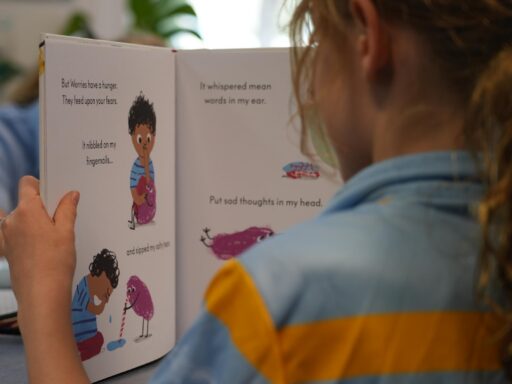
Writing a mathematics problem in a workbook requires a student to record each step, organise their thinking and see the progression of their work. Reading from a physical book allows them to concentrate on the text without notifications, hyperlinks or another application sitting a tap away.
These experiences can also make learning more visible to the teacher. A teacher can observe how a child is forming a letter, identify the exact point at which they have made an error in a calculation, or see whether they are struggling to decode a word. That allows immediate feedback, explanation and support.
There is nothing outdated about this approach. In many cases, it is precisely because we understand more about how children learn that these practices remain important.
A device does not automatically make learning better
Digital devices have transformed many aspects of our lives, but education presents a particular challenge.
A tool can make a task quicker or more convenient without necessarily making the learning deeper.
This distinction matters.
If the goal is for a child to learn to spell, develop handwriting fluency or solve a mathematical process independently, completing the activity digitally may not offer an advantage. In some cases, the technology can introduce additional demands that are unrelated to the skill being learned.
Australian research has highlighted this issue in writing.
A NSW Department of Education study investigated whether primary aged children performed differently when completing writing assessments on a computer compared with pen and paper. After accounting for a range of student, school and task factors, children in Years 2 to 5 scored lower on average in the computer-based writing tests than in the equivalent pen-and-paper tests, across both narrative and persuasive writing.
This does not mean that children should never type. Typing is an important skill and becomes increasingly relevant as children progress through school.
It does, however, reinforce an important principle: the medium through which a child completes a task can influence the learning experience.
Technology should therefore be chosen because it genuinely adds something, rather than simply because it is available.
Rethinking the assumption that digital means better
Neuroscientist and educator Dr Jared Cooney-Horvath has been prominent in challenging assumptions about the role of technology in education.
His work focuses on how people learn and the conditions that support attention, memory and deep thinking. Rather than approaching classroom technology as inherently good or bad, Cooney-Horvath argues that the important question is whether a particular technology actually helps children learn.
In his recent work on classroom technology, he has argued that schools need to look carefully at what changes when screens begin to replace activities such as handwriting, sustained reading, discussion, practice and direct human instruction.
That is a useful distinction.
Preparing children for the future does not require every learning experience to become digital.
A child can develop sophisticated digital skills later while first establishing secure foundations in literacy, numeracy, communication, attention and independent thinking.
In fact, those foundations are what allow them to use technology more effectively when it is introduced.
What about NAPLAN?
The role of devices in learning has recently returned to the national conversation.
Year 3 students continue to complete the NAPLAN writing assessment using pen and paper, while students in Years 5, 7 and 9 complete their writing assessment online.
Following the release of the 2026 NAPLAN results, Australian education ministers have also begun discussing whether there should be a greater return to pen and paper learning and assessment, alongside broader questions about screen use in schools.
It is important not to draw a simple conclusion that paper automatically produces higher NAPLAN results. Educational outcomes are influenced by teaching quality, curriculum, prior knowledge and many other factors.
But the discussion itself reflects a broader shift.
After more than a decade in which adding technology was often viewed as a sign of educational progress, schools are increasingly asking whether every digital substitution has actually improved learning.
That is a worthwhile question.
Learning to concentrate matters too
Devices also change the environment in which learning occurs.
Even when children are completing work on a device that enhances learning, the device offers multiple possibilities at once. There may be different applications, tabs, links, tools and alerts available within the same environment.
Learning, however, often requires the opposite: sustained attention on one thing.
Children need opportunities to read for extended periods, listen carefully to an explanation, persevere with a difficult problem and continue working when an answer does not come immediately.
Those habits are developed through practice.
Creating periods of the school day where a child has a book, workbook or piece of paper in front of them and nothing else competing for their attention can therefore be valuable in its own right.
It also creates more space for human interaction.
Students talk to one another. They ask teachers questions. They explain their thinking. Teachers read the room, empathise, respond to confusion and adapt their instruction.
Technology can facilitate communication, but it should not replace the human relationships through which so much learning occurs.
Digital capability still matters
None of this means schools should turn away from technology.
Students will enter universities, workplaces and communities in which technology and artificial intelligence will be deeply embedded.
They need to know how to research effectively, collaborate online, create digital content, evaluate sources, protect their privacy and use emerging technologies responsibly. All of which are taught through using the device as a production tool, not consuming information through an app or an ‘educational’ YouTube video.
The question is one of purpose.. Are you using the device to produce content, share ideas, collaborate, or are you using the device to consume content?
Rather than giving children unrestricted access to technology from their earliest years, schools can introduce devices progressively as students develop the knowledge, independence and judgement to use them effectively.
There is also a difference between learning about technology and completing all learning through technology.
A young child can learn the principles of Digital Technologies without spending every literacy and numeracy lesson on a device.
Likewise, an older student can become highly digitally capable while still handwriting notes, reading physical texts, discussing ideas face to face and sometimes closing the laptop entirely.
Being digitally prepared should mean knowing how to use technology well, including knowing when not to use it.
St Hilda’s approach: foundations first, technology with purpose
At St Hilda’s, this thinking sits within our broader philosophy of Being Human in a Digital Age.
Our approach is not anti-technology. It is deliberately age appropriate and centred on a simple principle: technology should enhance learning, not become the default way learning occurs.
In Junior Kindy and Kindy, girls are device-free for general teaching and learning.
From Pre Primary to Year 2, girls also learn without devices for general teaching and learning, with access to technology only when required for the Digital Technologies curriculum. This technology is not necessarily an iPad, but could be a codable robot, mechanical Lego or other STEM-based tools.
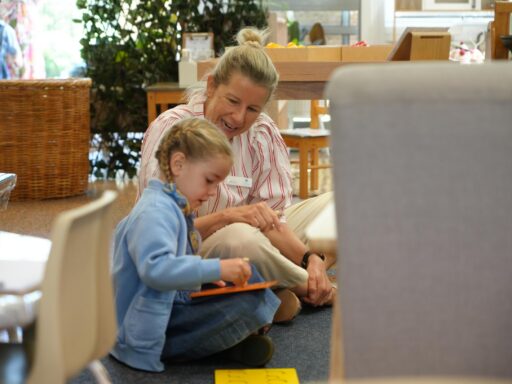
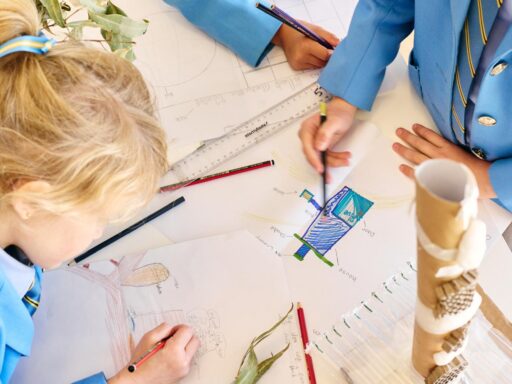
These early years deliberately prioritise the foundations of literacy and numeracy through explicit teaching, reading, handwriting, pencil-and-paper activities, workbooks, conversation, play and practical learning.
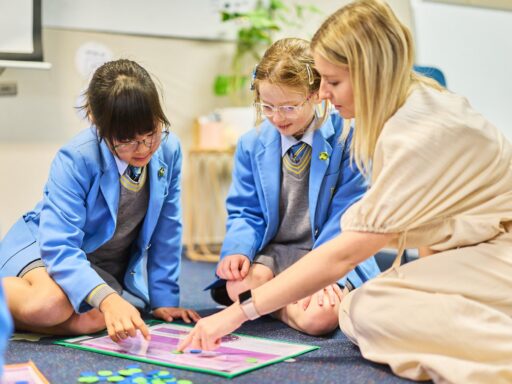
Girls have time to develop their pencil grip and fine motor skills, practise forming letters, work through mathematical problems on paper, read physical books and interact directly with their teachers and classmates.
From Years 3 to 6, technology is introduced progressively through school-managed devices that remain at school.
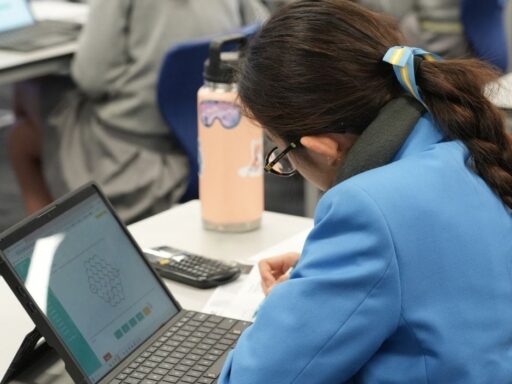
The devices are deliberately streamlined. Girls have access to the applications required for learning, production and collaboration, including OneDrive, OneNote, Teams, Word and PowerPoint, while unnecessary applications are removed.
“Educational apps” are not utilised in line with research showing they hinder learning rather than support it. Gaming, advertising based apps and unrestricted downloads have no place in the learning environment.
In Senior School, girls are provided with devices that can be taken home, reflecting their increasing independence and the greater role technology plays in secondary learning, research, collaboration and organisation.
Digital responsibility grows alongside that access.
Our approach extends to mobile phones, social media and artificial intelligence. Girls in Years 7 and 8 can use Professor Hilda, an in-house learning tool designed not simply to provide an answer, but to pose questions and prompt further thinking. From Year 9, girls have access to Microsoft Copilot alongside guidance around responsible and appropriate use of artificial intelligence.
School-managed devices are also supported by secure web filtering, security software and monitoring systems designed to provide additional protection and alert staff to concerning activity during school hours.
This staged approach is intentional.
We want our girls to leave St Hilda’s confident with technology and ready for a rapidly changing world.
But we also want them to be able to read deeply, write fluently, concentrate for extended periods, solve problems without immediately reaching for a device, talk through ideas, question information and think for themselves.
Technology will continue to change. Those skills will not.
Perhaps the question for schools is therefore not how early we can put a device into a child’s hands, but when that device becomes the best tool for the learning we want to achieve.
Want to see how this approach comes to life at St Hilda’s? Book a tour or explore our Teaching and Learning approach to discover how we support girls to build strong foundations and grow as confident, capable learners.