Teaching and Learning

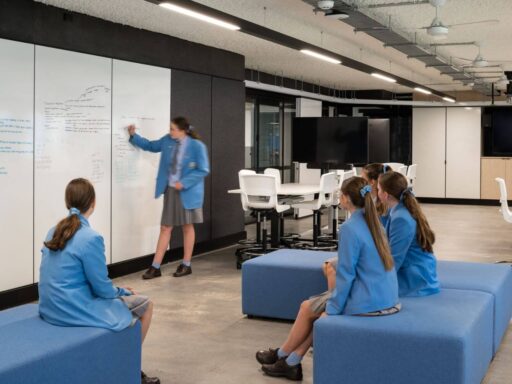
A St Hilda's teacher assists children with their class work, fostering a supportive and engaging learning environment.

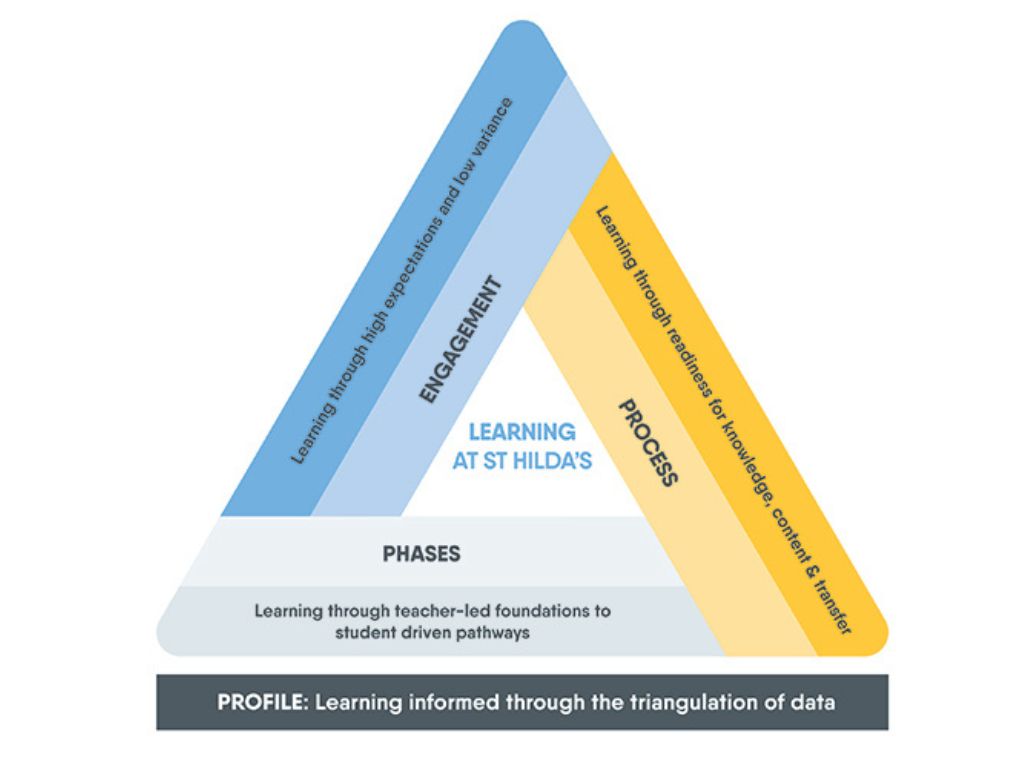
At St Hilda’s, we believe every student is capable of achieving academic success. Our approach to teaching and learning is data-informed, evidence-based, and grounded in educational research, ensuring that each student experiences a responsive and relevant education. We are committed to a culture of continuous improvement, where every girl is supported to reach her full potential.

The Art of Teaching and the Science of Learning

At St Hilda’s, effective teaching brings together the Science of Learning and the Art of Teaching to create engaging and meaningful experiences that optimise student growth.

The Science of Learning is grounded in cognitive psychology and educational research. It focuses on how students acquire, retain, and retrieve knowledge, offering evidence-based insights into how the brain processes information.
The Art of Teaching is the skilled application of this science. It is the teacher’s ability to know when and how to use evidence-based practices, responding intuitively to the needs of their students.

Together, they form the foundation of high-quality, impactful teaching at St Hilda’s.

Differentiated Learning

We understand that students progress through the learning process at different paces—moving from knowledge recall, to contextual understanding, and finally to deep transfer of learning. To support this journey, we provide a range of pathways and practices: 

  • Intervention 
  • Support
  • Differentiation
  • Enrichment
  • Acceleration 

This structure allows us to personalise learning so that every student is both supported and challenged. 

Differentiation

We believe that differentiating instruction is key to ensuring that every student can achieve academic success. Our teachers use a variety of strategies, such as flexible grouping, tiered assignments, and scaffolded tasks, to differentiate instruction and meet the needs of diverse learners. This approach to teaching and learning happens within the classroom and is based on the teacher’s professional judgement as to who needs a differentiated task. We recognise that differentiation requires ongoing assessment, reflection, and adjustment, and we are committed to providing ongoing professional development to support out teachers in this endeavour.

Enrichment

For students looking for additional academic stretch, a range of enrichment opportunities are on offer. Students can explore their interests and passions through activities such as clubs, cocurricular activities, competitions, and in Senior School, elective courses. Our teachers use a variety of pedagogical approaches, such as project-based and experiential learning, to stimulate intellectual curiosity and foster a love of learning. St Hilda’s appreciates that engagement in learning at a deeper level is key, not simply volume of work.

Acceleration

At times, students display a level of academic achievement that is beyond their academic grade. When that is apparent, the school recognises that they may require more advanced instruction to reach their full potential. Our teachers use data to identify gifted and talented students and provide accelerated learning opportunities. This includes whole-year acceleration, subject acceleration or advanced courses.  

Support

At one point in time, nearly every student needs additional support. As each student has differing abilities within various subjects at school, this support is needed at a variety of times and for different content. Using data to inform a process, students are grouped in or out of class to work within a small group setting. In a small-group context students are provided with opportunities to engage in repetition of content to consolidate and address gaps in learning. St Hilda’s Tutoring Centre, open before and after school, is staffed with teachers who can provide additional support for those who seek it.

Intervention

Assistance programs are a critical component in supporting students who have significant gaps in their learning or a diagnosed learning challenge. Before implementing an intervention program further diagnostic testing is completed. This process highlights the specific needs of the student. Based on those needs, the targeted program is chosen and delivered. This intervention may included 1:1 or small group support before, during or after school time.

High Expectations and Low Variance

At St Hilda’s, high expectations are central to student success. When teachers believe students can achieve and provide the right balance of support and challenge, learners rise to meet those standards. 

Equally important is low variance; the consistency of expectations, routines, and behaviour across classrooms. This ensures a cohesive and predictable environment for students. Our approach is framed around four key principles: 

  • Prepared – students arrive ready to learn, with materials, prior knowledge activated, and routines understood. 
  • Polite – students treat others with kindness and respect, creating a safe and supportive learning environment. 
  • Productive – students engage fully in their learning, taking responsibility for their effort and progress. 
  • Pridestudents take pride in the presentation, quality, and level of effort in their work.

Data-Informed Teaching and Learning

Central to our framework is a commitment to knowing each student as both a learner and a person. Being data-informed means using evidence to understand student strengths, needs, and growth, ensuring that every girl is visible and valued.

St Hilda’s is leading the way in how triangulated data is analysed and applied to support the holistic development of our students, ensuring we meet their academic, social, and emotional needs.

Gifted and Talented Opportunities

St Hilda’s has a number of opportunities embedded within the curriculum programs for all students (regardless of their aptitude for the subject) and opportunities outside the classroom. Our girls have access to competitions, programs, and experiences that rival even the state’s top selective schools.

St Hilda’s Mensa accreditation recognises our commitment to fostering giftedness.


 

Acceleration programs for gifted and talented students such as the da Vinci Decathlon and Tournament of Minds allow girls to connect with like-minded souls to test their knowledge, creativity and problem-solving skills. Read our blog article from our Gifted and Talented Coordinator.


Find out more about our Gifted and Talented program

How St Hilda's prepares your daughter to be Future Ready

At St Hilda’s, we believe education should go beyond simply preparing your daughter for exams. While we take pride in our exceptional academic achievements, we also recognise that the landscape of learning is constantly evolving.

TUTORING CENTRE

St Hilda’s has numerous strategies in place to support the girls to meet their academic goals. The Tutoring Centre is an innovative hub of academic support for students in Years 7 to 12 who are welcome to attend as often as the need arises.

Specialist teachers from all subject areas are available for one-on-one or small-group teaching and learning. Students may need to clarify a concept taught in class or seek extension work to improve their marks. Individualised instruction helps girls to reach their academic goals and take charge of their learning.

The Centre’s Coordinator teaches students how to maximise exam time and study and research effectively and is available each day at lunchtime and after school to assist with essay writing, time management and study skills.

Differentiated programs of study are devised for girls who require adjusted timetables due to illness, elite sports commitments or particular circumstances.