How to know if your child’s school is building deep thinking into learning.
Curiosity is often described as one of the most important qualities a child can have. Parents want their children to be interested in the world, to ask questions, explore ideas and enjoy learning.
But in primary school, curiosity on its own is not enough.
A child can ask a question. But can she work out what kind of question it is? Can she find the information she needs? Can she decide whether that information is reliable? Can she think about it carefully, connect it to what she already knows, and use it to form her own view?
That is where curiosity becomes more than interest. It becomes learning.
The strongest primary schools do not choose between knowledge and curiosity. They teach both. They build strong foundations in content, while also teaching children how to think within that knowledge, so their questions become deeper, richer and more meaningful.
Because curiosity is only as strong as the knowledge and thinking behind it.
Why knowledge still matters
In recent years, there has been a lot of discussion about whether schools should focus more on knowledge or skills. It is an understandable question. We want children to be creative, adaptable and curious. We want them to solve problems, think critically and communicate well.
But children cannot think deeply about something they know very little about.
Knowledge gives children the material their thinking works with. It gives them language, context, examples, facts, vocabulary and reference points. Without knowledge, curiosity can remain shallow. A child may be interested, but not yet equipped to go further.
For example, a child might ask:
What was the Eureka Stockade?
That is a valid question. It shows interest and curiosity. But it is also a question that can largely be answered through content knowledge. A child can read, listen, research and learn the key facts.
But a deeper question might be:
Whose side would I have been on if I were at the Eureka Stockade?
That question cannot be answered by simply finding a sentence in a book. It requires knowledge, but it also requires thinking. The child needs to understand the historical context, the different perspectives, the ideas of fairness and authority, the risks people faced, and the values that shaped their decisions.
- She needs to analyse.
- She needs to evaluate.
- She needs to imagine herself within the knowledge.
- She needs to think.
That is the difference between asking a question and asking a powerful question.
| A question a child can look up | A question a child has to think through |
|---|---|
| What was the Eureka Stockade? | Whose side would I have been on, and why? |
| What does this creature need to survive? | How would this habitat change if one species disappeared? |
| What is this object made of? | Why does this material suit this design when another would not? |
| What happened in this event? | Whose story is being told, and whose voice is missing? |
The left column can be answered by finding information. The right column can only be answered by thinking with it.
Not all questions are equal
It is easy to say that children should ask more questions. But not all questions take learning equally far.
- Some questions help children gather information.
- Some help them notice patterns.
- Some help them compare ideas.
- Some help them test assumptions.
- Some ask them to make judgements.
- Some invite them to create something new.
A strong primary school helps children understand this difference.
It does not simply encourage children to ask anything. It teaches them how to ask better questions. Questions that are grounded in what they have learned. Questions that require evidence. Questions that lead to explanation, reasoning, debate, design, creativity and reflection.
This matters because deep curiosity is not random. It is built.
Children need teachers who explicitly teach knowledge, model thinking, guide discussion and help them understand what makes a question worth pursuing.
Nine signs a primary school is really building curiosity
For parents, this can be difficult to judge from the outside. A classroom may look lively and creative, but that does not always mean the learning is deep. Equally, a classroom that includes explicit teaching, handwriting, reading, practice and knowledge building may be doing the essential work that later allows curiosity to flourish.
So what should parents look for?
A school that genuinely builds curiosity should be able to show how children are taught to:
- build strong content knowledge
- ask thoughtful questions
- connect ideas across subjects
- explain their thinking
- listen to other perspectives
- test and refine ideas
- apply knowledge in new situations
- create, design or communicate something meaningful
- reflect on what they now understand
Curiosity should not sit outside the curriculum as something occasional or decorative. It should be deliberately built into learning.
From asking questions to thinking deeply
In the primary years, children are developing the habits that will shape how they learn for many years to come. They are learning whether school is about getting the answer quickly, or thinking carefully. Whether knowledge is something to memorise and forget, or something to use. Whether questions are a sign of confusion, or a pathway to deeper understanding.
This is why knowledge and thinking need to work together.
When children learn rich content, they have something to be curious about. When they are taught how to think, they can do something meaningful with that curiosity.
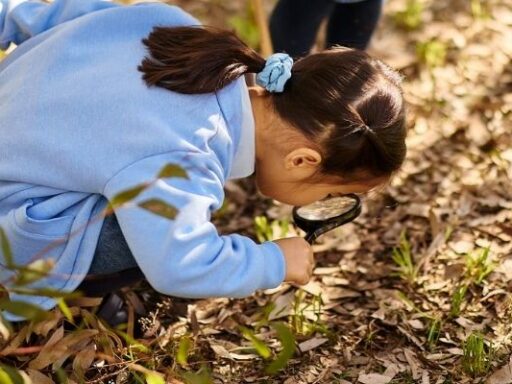
A child learning about living things may begin by asking what a creature needs to survive. With the right knowledge and guidance, that question can grow into a deeper investigation of habitats, ecosystems, interdependence and environmental change.
A child learning about materials may begin by asking what something is made of. With deeper thinking, she can explore why materials behave differently, how they can be used in design, and what makes a solution strong, sustainable or effective.
A child learning about history may begin by asking what happened. With deeper thinking, she can consider whose story is being told, whose voice is missing, and how the past continues to shape the present.
That is when curiosity moves beyond finding answers. It becomes a way of thinking.
How St Hilda’s Junior School builds curious minds
At St Hilda’s, our Junior School approach is grounded in the belief that girls need both strong knowledge and the ability to think deeply.
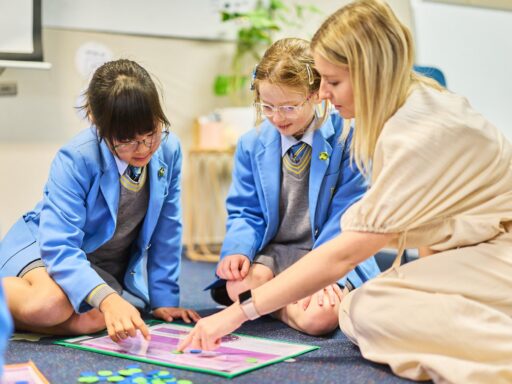
Our Units of Curiosity are not simply about asking questions. They are designed to help our girls ask the right questions, based firmly in explicitly taught knowledge and explicitly taught thinking.
Across Years 1 to 6, our girls explore purposeful, connected units that draw together knowledge, inquiry and application. They might investigate how tiny creatures interact with their environments, explore how sound is created and represented, consider how materials influence design, examine how communities change over time, or think about how living things are connected through habitats and interdependence.
In other units, our girls explore ideas such as chocolate production and sustainability, bushfire impacts and fire-smart solutions, the movements of Earth and their relationship to day, night, seasons and tides, migration and belonging, the lifecycle of clothing, or the way energy is transferred and transformed.
These units give our girls rich content to work with. But the purpose is not simply to know more. It is to think more deeply.
Our girls are encouraged to question, analyse, connect, evaluate and create. They learn that curiosity is not just about wondering. It is about having the knowledge, confidence and thinking skills to pursue an idea and take it further.
Because a curious mind is not just a mind that asks questions.
It is a mind that knows how to think.
Keep Exploring
See how curiosity and strong foundations grow together in our Junior School, 或 预约参观 to see for yourself.
Common questions from parents
Is knowledge or curiosity more important in primary school?
Neither works well without the other. Knowledge gives children something to be curious about, and thinking skills let them do something meaningful with that curiosity. The strongest primary schools teach both deliberately, rather than choosing one over the other.
What is inquiry learning in primary school?
Inquiry learning is an approach where children build knowledge and then use it to ask questions, investigate, and form their own understanding. Done well, it is grounded in explicitly taught content, not open-ended activity. The knowledge comes first, and the questions grow from it.
How can I tell if my child’s school teaches deep thinking?
Look past how lively the classroom appears. Ask how the school builds content knowledge, teaches children to ask better questions, and helps them explain, test and apply their ideas. Depth shows up in how children reason, not in how busy the room looks.