学业成功

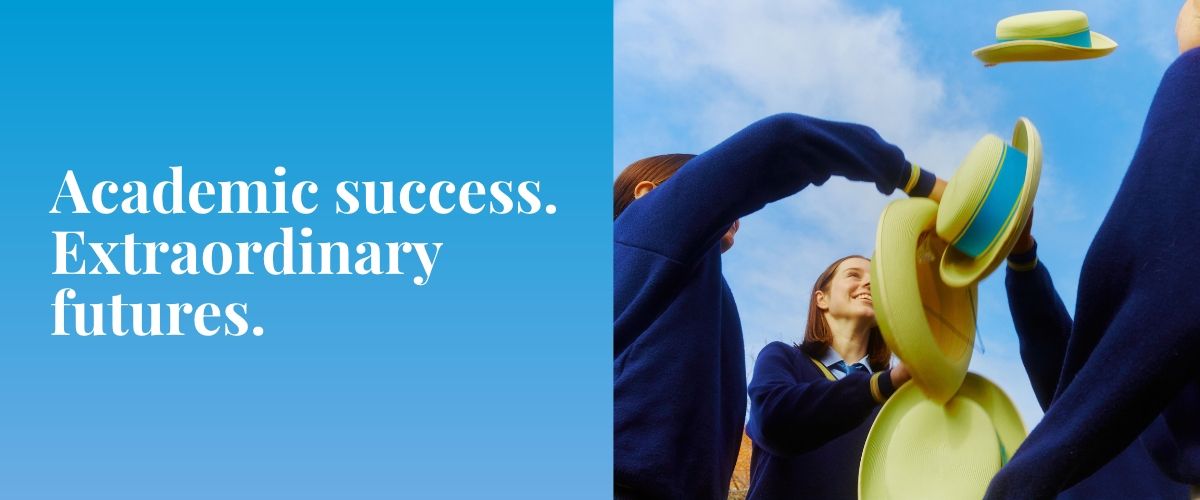
Students celebrate outdoors tossing hats into the air beside a blue gradient with the slogan 'Academic success. Extraordinary futures.'

Academic excellence at St Hilda’s

Academic success. Individual pathways. Extraordinary possibilities.

At St Hilda’s Anglican School for Girls, academic excellence is about more than achieving outstanding results. It is about equipping every girl with the knowledge, skills and confidence to thrive at university, in the workplace and in a rapidly changing world. 

With 99% of our girls university bound, St Hilda’s has a strong history of academic achievement, underpinned by high expectations, expert teaching, evidence informed practice and personalised academic support. 

Our girls are encouraged to think deeply, challenge themselves and develop the confidence to pursue ambitious goals. For many, that pathway focuses on ATAR courses. For others, it combines ATAR courses with certificate qualifications, workplace experience and/or university enabling courses. 

Success does not look the same for every girl. What matters is that every girl leaves St Hilda’s with strong foundations, meaningful choices and the confidence to make the most of them. 

Explore Teaching and Learning

2026 Academic Results

Strong Academic Outcomes

St Hilda’s consistently achieves academic results that place St Hilda’s among Western Australia’s leading independent schools.

The Class of 2026 continued St Hilda’s long tradition of strong academic achievement.

XX.XX
Top ATAR Score
XX%
Achieved an ATAR Above 98
XX%
Achieved an ATAR Above 95
XX%
Achieved an ATAR Above 90
Two people shake hands on stage, blue-lit foreground with a red, blurred background behind them.

Recognised Excellence

圣希尔达学院 女孩 have been recognised for their outstanding academic achievement in Year 12, receiving an impressive collection of School Curriculum and Standards Authority (SCSA) Awards in recognition of their performance in Year 12 courses relating to the Western Australian Certificate of Education (WACE). 

🏆 X General Exhibition
🥇 X Subject Exhibitions
⭐ X Subject Certificates
🎖️ XX Certificates of Distinction
📜 XX Certificates of Merit

Understanding results

Is an ATAR a percentage?

No. An ATAR is a rank, not a mark. An ATAR of 90+ means a girl has performed in the top 10% of the state. It does not mean that a girl  achieved 90% in their courses.

What is the highest possible ATAR?

The highest possible ATAR is 99.95.

Do Mathematics Methods, Mathematics Specialist and Languages receive an ATAR incentive?

Yes. For students completing Year 12 in 2026, a 10% bonus applies to Mathematics Methods, Mathematics Specialist and a student’s best eligible Language Other Than English These bonuses are added to the Tertiary Entrance Aggregate even if the course is not included among the student’s top four subjects. As tertiary admission rules can change, this information should be reviewed each year against current TISC guidance.

Should students choose courses because they scale highly?

Not necessarily. Scaling is designed to make results across different ATAR courses comparable, and the way courses scale can vary from year to year. At St Hilda’s, subject selection focuses on a girl’s strengths, interests, prerequisites and intended pathway. Choosing courses in which she can perform strongly is more valuable than selecting a subject solely because of assumptions about scaling.

What is the difference between WACE, TEA and ATAR

  • WACE (Western Australian Certificate of Education):  Is the official high school graduation certificate earned by by completing Year 11 and Year 12. This involves meeting specific completion, breadth, and depth requirements, and passing literacy and numeracy standards (achieved via NAPLAN or OLNA). WACE can be achieved through ATAR courses, General courses, Vocational Education and Training (VET) or endorsed programs 
  • TEA (Tertiary Entrance Aggregate): is the total scaled score number calculated by adding a girl’s best four Year 12 course scores, after the addition of any bonuses. This aggregate number is used to rank students and determine their Australian Tertiary Admission Rank. 
  • ATAR (Australian Tertiary Admission Rank) is a ranking between 0.00 and 99.95 used by Australian universities to compare Year 12 students for university admission. Importantly, an ATAR is not a percentage or a mark. It indicates a student’s position relative to other students of the same age.


Do you need an ATAR to go to university?

No. An ATAR around 70 can provide direct entry to a range of undergraduate courses, although requirements vary between universities and courses and some degrees require significantly higher results or additional prerequisites. 

There are also pathways to university that do not rely solely on an ATAR. Depending on the institution and course, these can include university enabling or preparation programs, recognised VET qualifications, experience based entry, portfolio or audition entry for selected courses and other access pathways. 

At St Hilda’s, pathway planning is about helping each girl understand the options available to her and choosing a program that supports her strengths and ambitions.

How are school course results reported?

SCSA publishes tables identifying schools with high performing students in individual Year 12 ATAR courses. To appear in these tables, a school must have at least 10 students in that course. Schools are not listed where fewer than 10% of those students achieved combined scores within the top 15% statewide. 

This means students in a smaller subject cohort may achieve exceptional individual results without their school appearing in the published course table. At St Hilda’s, we believe girls should have access to course that align with their strengths, interests and intended pathways. A valuable course should not disappear simply because a cohort is small.

Why we do not publish a median ATAR

A clearer picture of academic success

A clearer picture of academic success 

At St Hilda’s, we are deliberate about how we report and celebrate Year 12 academic achievement. 

We do not routinely name individual girls or publish their personal ATAR results, recognising that academic outcomes are personal achievements and that not every girl wishes for her results to be shared publicly. This approach respects each girl’s privacy and agency while reinforcing a culture in which achievement is celebrated collectively rather than treated as a competition between girls. 

Our focus is on the strength and growth of the cohort as a whole, including progress, effort and achievement over time. This allows us to celebrate strong academic outcomes while remaining consistent with our commitment to the wellbeing and individual needs of every learner. 

We take a similarly transparent approach to median ATAR reporting. 

From 2010 to 2021, the Tertiary Institutions Service Centre (TISC) independently calculated a median ATAR for every Western Australian secondary school. In February 2022, the TISC Board decided to cease calculating and publishing school median ATARs, noting concerns that median ATAR had increasingly become a comparative school performance measure and could create an incentive for some students to be directed away from ATAR courses in order to increase a school’s median. 

As a result, any median ATAR published by an individual school for cohorts from 2022 onwards is calculated by the individual school rather than independently calculated by TISC. 

St Hilda’s therefore does not publish a  median ATAR . We continue to monitor our internal median as one of a number of measures used to understand cohort performance, growth and achievement, but do not present it as an independently verified comparison with other schools. 

Instead, we publish the percentage of our ATAR students achieving above key benchmarks. This provides families with a transparent view of the depth of academic achievement across the cohort and allows results to be considered across a range of performance levels.

Universities St Hilda’s Graduates Attend

Our graduates’ destinations provide another important measure of academic success: whether girls leave St Hilda’s able to access the courses, institutions and opportunities that align with their ambitions. 

Our graduates pursue studies across fields including medicine and health sciences, law, engineering, commerce, science, technology, design, the humanities and performing arts. 

For us, it’s more about a graduate’s ability to make the most of what comes next.


西澳大利亚州
The University of Western Australia, Curtin University, The University of Notre Dame, Murdoch University, Edith Cowan University, WAPPA
澳大利亚
Australian National University, Bond University, RMIT University, Monash University, La Trobe University, UNSW Sydney
International
University of Oxford, Princeton University, Columbia University, University of San Francisco
Two children are writing algebra equations on a glass board, seen from behind, with blue marker in hand

Academic growth matters

Challenge. Support. Progress

Strong Year 12 results begin well before Year 12. 

At St Hilda’s, academic progress is monitored over time so teachers can identify when a student is ready for greater challenge, when additional support may be needed and where targeted teaching can make the greatest difference. This allows us to focus not only on where a girl finishes, but on the progress she makes along the way. 

Our aim is for every girl to be appropriately challenged, well supported and increasingly confident in herself as a learner. 

More than one pathway to success

There is no single definition of success and no single pathway beyond school. 

Girls at St Hilda’s can pursue an ATAR pathway or a Blended Pathway, which may include vocational education and training, certificate qualifications or a combination of courses, depending on their strengths, interests and goals. 

Planning begins before the senior years. Through career exploration, subject counselling, work experience and individual pathway conversations, girls are encouraged to understand what interests them, where their strengths lie and which subjects will keep appropriate opportunities open. 

Some girls have a clear destination in mind. Others are choosing between very different possibilities. 

Both are valid places to begin. 

Explore Pathways and Possibilities

Different pathways. Strong outcomes.

A key part of the senior years’ experience at St Hilda’s is the opportunity to engage in real-world learning. Through partnerships with TAFE and specialist providers, students can explore industry-focused learning in a range of industries. 

Congratulations to the students who undertook Certificates in: Preparation for Health and Nursing Studies, Fitness, Zoology, Business, Community Services, Animal Care Services, Hospitality and Geography. 

21
Certificate IV
1
Certificate III
3
Certificate II

More than academic results

Academic foundations give our students choices. What they learn alongside those foundations helps them use those choices well. 

Think critically 

Girls learn to question, analyse, make connections and approach complex problems with intellectual curiosity. 

Create and act 

Entrepreneurial learning develops creativity, problem solving, collaboration and the confidence to turn an idea into action. 

Lead authentically 

Leadership is not defined by a badge or title. Girls learn to know themselves, contribute, influence positively and create opportunities for others. 

Adapt and grow 

Students learn that progress does not always come easily. They are encouraged to seek feedback, learn from setbacks and keep developing. 

Lift others as they rise 

The culture of girls lifting girls matters well beyond graduation. Our students learn that individual achievement and supporting others are not competing ideas. 

Girls who lift girls become women who lift women.

Strong Foundations. Meaningful Choices.

Hands of a student lighting a Bunsen burner with a lit match at a lab bench during a chemistry experiment, flame rising.

Book a tour to see how St Hilda’s helps every girl reach her potential 

预订参观